

Minimalism is no longer a style but a signal. This is how restraint became a language of taste, and how to distinguish substance from performance.
The silence is the point
Minimalism is no longer about having less. It is about saying more with less.
Empty space, limited objects, controlled palettes. These are not neutral decisions. They communicate judgement. They imply that what remains has been selected, not merely left behind. The room is no longer arranged to impress. It is arranged to suggest that impressing is unnecessary.
This is the shift. Minimalism has moved from aesthetic preference to cultural code.
Silence, in this context, is not absence. It is a message.
How restraint became status
Status once relied on visibility. More objects. Larger gestures. Obvious expense.
That language has weakened.
In its place, a quieter signal has emerged. The ability to edit. To own less, but to choose correctly. To remove without revealing uncertainty. To present only what can withstand scrutiny.
This is not modesty. It is control.
Restraint now implies:
- access to better options
- confidence in selection
- literacy in what matters
- indifference to excess
It is a more credible signal because it is harder to fake convincingly. Or at least, it was.
Curation versus absence
Minimalism without judgement is simply emptiness.
The distinction is precise and non negotiable:
- Curation is selective. It is built on inclusion.
- Absence is subtractive. It is built on removal.
A sparse room is not inherently considered. It becomes considered only when what remains carries weight, materially, visually, and intellectually.
An empty wall does not signal taste. A wall that holds a single, correct work does.
This is where most minimalist interiors fail. They confuse reduction with resolution.

One chair, a strip of sea and room around both. Off Duty gives restraint a specific subject.
The performance of discernment
Minimalism now operates as a form of social shorthand.
A carefully placed book is not only read, it is seen. A chair is not only functional, it is referenced. A photograph is not only displayed, it is positioned as evidence of taste.
The composition becomes rhetorical.
Common signals include:
- books chosen for cultural alignment rather than use
- furniture selected for recognisability rather than comfort
- art that appears restrained but carries no authorship
- negative space used to imply confidence, but revealing hesitation
This is not accidental. It is staging.
The room performs discernment. Whether that discernment is real is a separate question.
Why photography matters in this language
Fine art photography sits naturally within this visual economy.
It does not rely on scale or ornament. It operates through precision. It can hold space without overwhelming it. It rewards attention rather than demanding it.
More importantly, it carries authorship.
A photograph, when selected correctly, introduces:
- a point of view
- a defined frame of reference
- a controlled visual weight
- a quiet but undeniable authority
It does not need to fill a wall to justify its presence. It needs to be right.
In a restrained interior, photography becomes one of the few elements capable of carrying meaning without disrupting the silence. That is why it appears so frequently in spaces that aim to communicate judgement rather than decoration.
What real judgement looks like
Genuine curation is not decorative. It is structural.

It is visible in decisions that hold under scrutiny:
- Coherence: The space reads as intentional. Nothing feels incidental.
- Material quality: Objects carry weight. Surfaces matter. Finishes are deliberate.
- Authorship: Work is attributable. It is not anonymous or interchangeable.
- Placement: Objects are positioned with spatial awareness, not convenience.
- Restraint with conviction: Fewer items, but no hesitation in what remains.
Real judgement does not announce itself. It reveals itself over time.
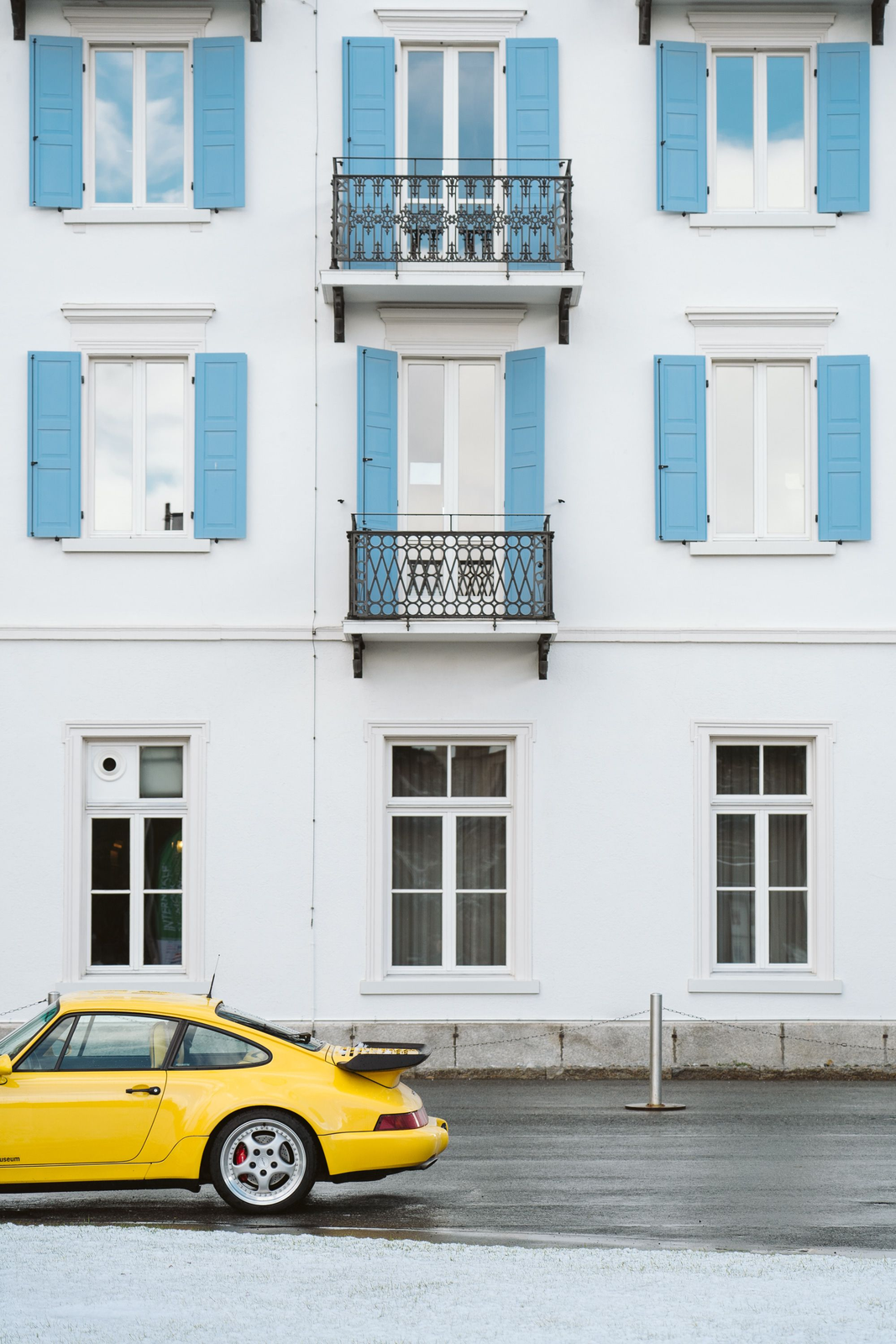
A Little Colour makes its point with a yellow car and blue shutters. Restraint need not mean removing the colour.
The failure case
The failure of contemporary minimalism is not subtle.
It appears as:
- generic beige palettes with no material depth
- oversized emptiness used to disguise lack of selection
- anonymous prints posing as art
- furniture chosen from recognisable catalogues without context
- spaces that feel algorithmic rather than authored
This is scarcity theatre.
It mimics the surface of restraint without the substance behind it. It borrows the language of taste but cannot construct a sentence.
The result is not calm. It is hollow.
The difference that matters
The meaningful distinction is not minimalism versus maximalism.
It is substance versus signal.
Restraint has value only when it is earned, through selection, understanding, and material care. Without that, it becomes branding. A visual strategy designed to suggest judgement rather than demonstrate it.
Silence, when constructed properly, is exacting. It leaves no room for error. Every element is exposed.
That is its power.
And its risk.
Final takeaway
Minimalism is no longer defined by what is removed, but by what remains, and why.
The difference between a considered space and an empty one is not volume. It is authorship.
Restraint is credible only when it is specific.
Anything else is performance.
Give one photograph room
Start with the wall and the light. Compare photographs for living spaces before choosing a size.
See living room photographsQuestions and answers.
Filed 12 April 2026, under Living with art.


