Expensive prints often signal luxury without substance. This piece reframes photographic value through authorship, material, and enduring visual depth.
Not all large prints are significant. Many signal luxury through scale, contrast, and immediate impact, yet offer little to return to. The distinction is not subtle once seen. It rests in authorship, material, and a kind of visual depth that resists quick consumption.
The rise of generic luxury
Across contemporary interiors, a certain photographic language has become dominant. Oversized compositions, heightened contrast, simplified subjects. They are designed to register quickly, to fill space, to align with a palette rather than challenge it. Their success lies in compliance.
This is not accidental. Such images are engineered to operate as décor. They resolve a wall. They do not ask to be read.
Why expensive does not mean meaningful
Price, scale, and finish can create the appearance of importance. Large formats command attention. Gloss surfaces amplify colour. Framing can confer weight. Yet these are external signals. They do not speak to the image itself.
Collectible work holds independently of its presentation. Reduce it, quiet it, and it still carries presence. Decorative work relies on its amplification.
“What sits on the wall is only part of the story. The rest is carried in intent, restraint, and material.”
Photography as authorship, not decoration
Serious photography begins with a point of view. An image sits within a body of work, informed by decisions that extend beyond a single frame. Light, timing, distance, and omission are not incidental. They are part of a language.
To recognise this is to move from matching an image to a room towards understanding what the image is doing. It is a shift from surface to authorship.
What substance looks like in an image
Enduring photographs rarely announce themselves loudly. They hold through restraint. Tonal transitions are measured rather than forced. Composition allows for ambiguity. There is space for the eye to move and return.
Often, the subject is less important than the treatment. A quiet scene, precisely observed, will outlast a dramatic one engineered for impact. The difference is felt over time rather than at first glance.
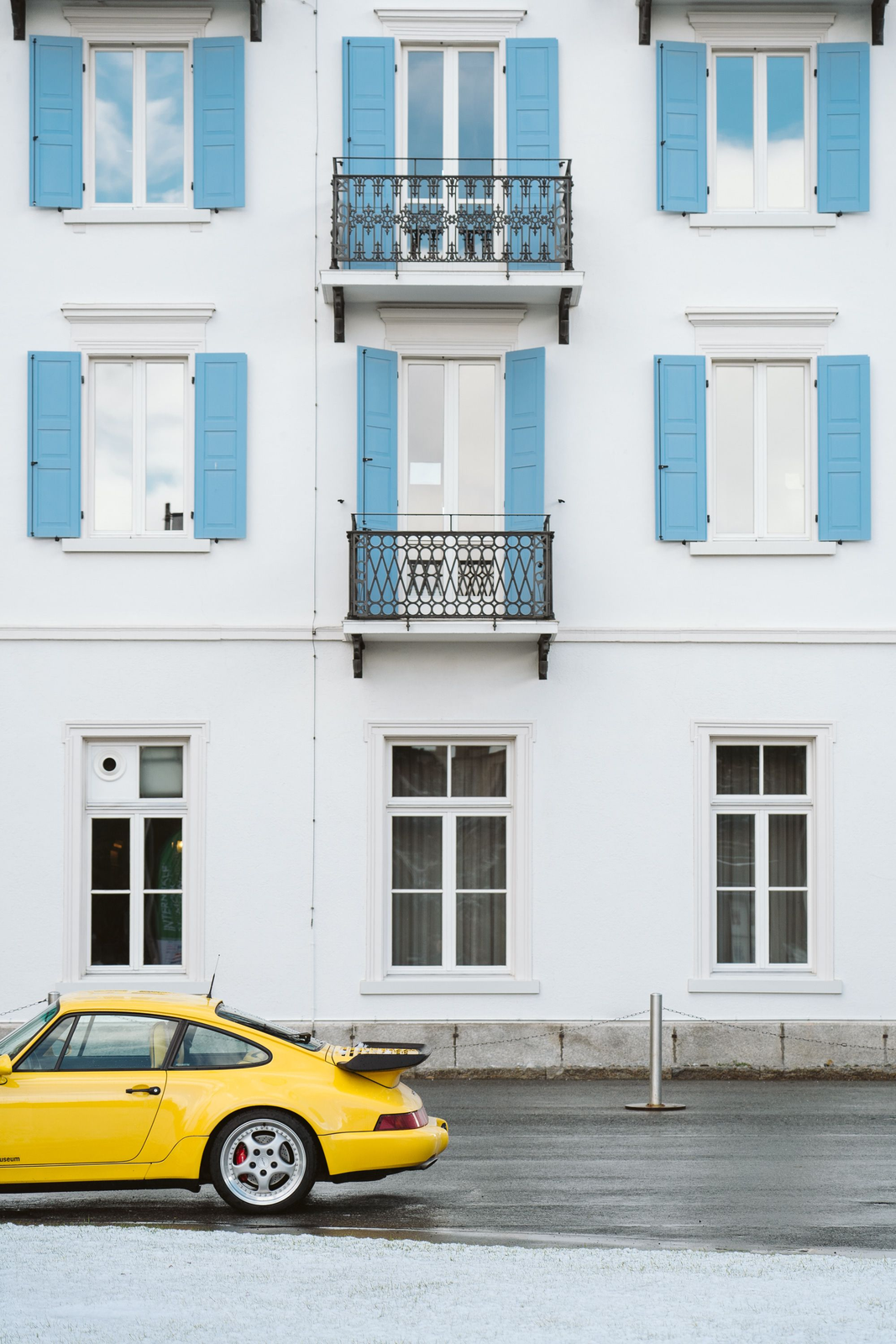
A Little Colour by David Szabo. The yellow car is the first thing you see; the blue shutters and iron balconies give you reasons to keep looking.
The role of material in perceived depth
Material is not a secondary consideration. It shapes how an image is read. Gloss surfaces tend to flatten nuance, pushing contrast forward. Matte, cotton-based papers absorb light, allowing tonal detail to emerge gradually.
This is where print becomes object. A paper such as Hahnemühle Photo Rag 308 offers a soft, almost velvety surface that carries subtle gradation without glare. Blacks sit deeper, highlights remain controlled. The image feels held rather than displayed.
How generic prints reveal themselves over time
Images designed for immediate effect tend to exhaust themselves. Once their visual idea is grasped, there is little left to uncover. They become background.
By contrast, photographs with depth retain a degree of resistance. They are not fully legible at once. Light shifts across them. Details surface slowly. They remain active within a space.
Developing a collector’s eye

Discernment is less about rules than attention. Certain qualities tend to signal substance:
- Restraint in contrast and colour
- Compositional clarity without rigidity
- A sense of intent beyond the single image
- Material choices that support, rather than dominate, the photograph
Over time, these become intuitive rather than analytical.

Canal Street by Jordan Cahill holds traffic, buildings and distant light within a narrow frame. Look at the photograph before deciding how much wall it needs.
Living with photography, not just placing it
Meaningful work alters a space differently. It does not simply complete it. It introduces a point of focus that evolves with familiarity. The room becomes a setting for the image as much as the image is an element within the room.
A quieter definition of luxury
Luxury, in photographic terms, is not spectacle. It is the convergence of intent, material, and time. It is the sense that an image will continue to reveal itself long after its placement.
The collector’s eye is not acquired through acquisition, but through attention. What endures is rarely the loudest presence on the wall.
Explore considered photography
A curated selection grounded in authorship, material integrity, and quiet permanence.
View collectionQuestions and answers.
Filed 9 April 2026, under Collecting & craft.